Natural Stone Benchtop vs Caesarstone: The Real Differences
12/06/2026
Caesarstone
Caesarstone
The natural stone benchtop conversation tends to split into two halves. The first happens in the showroom, where the focus is veining, movement, and the appeal of a material formed in the earth. The second happens in the kitchen a few years later, when homeowners notice a dull patch where the lemon sat overnight, or the faint ring left by a wine glass that wasn’t wiped fast enough.
Natural stone is beautiful. It also carries a set of practical commitments that don’t always surface during the selection process. Understanding the differences between natural stone and Caesarstone® surfaces is worth doing before the decision is made, not after.
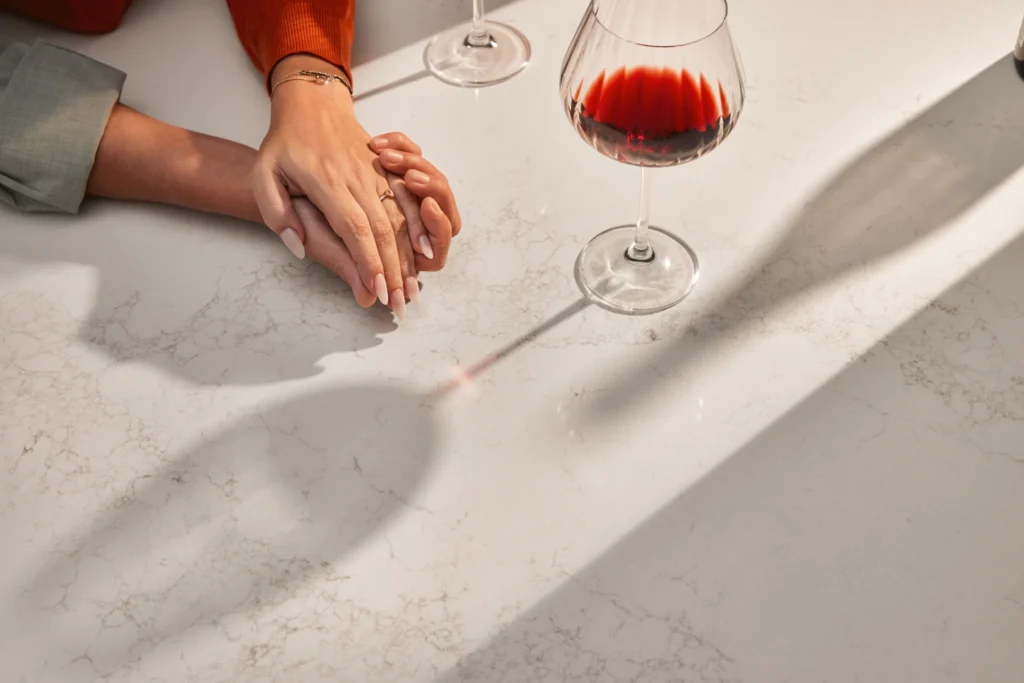
Marble, limestone, granite and quartzite are all porous to varying degrees. Porosity is what makes natural stone susceptible to staining from common kitchen substances like red wine, tomato paste, turmeric and olive oil. It’s also what makes softer stones such as marble and limestone prone to etching from acidic contact. Lemon juice, vinegar and some household cleaners can leave dull marks on the surface within minutes.
Caesarstone® surfaces are non-porous. They resist staining from the same substances that mark natural stone, and day-to-day care comes down to warm soapy water and routine wiping. For the full breakdown, read the care and maintenance guide.
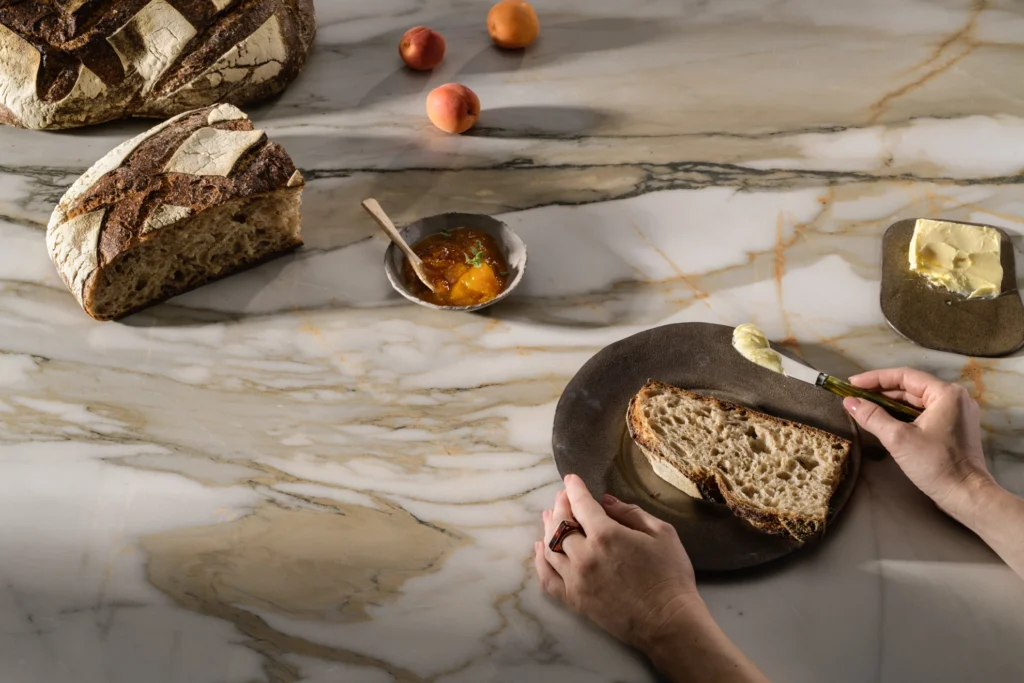
To keep natural stone in its original condition, sealing is required on a recurring basis. Granite and quartzite typically need resealing every one to two years. More porous stones, including marble and limestone, require sealing every six to twelve months. Softer natural stones such as travertine and certain marbles are also more vulnerable to scratching and chipping than engineered alternatives.
Caesarstone® surfaces don’t require sealing at any point in their lifespan, and are scratch and heat resistant by design, and are backed by a lifetime warranty.
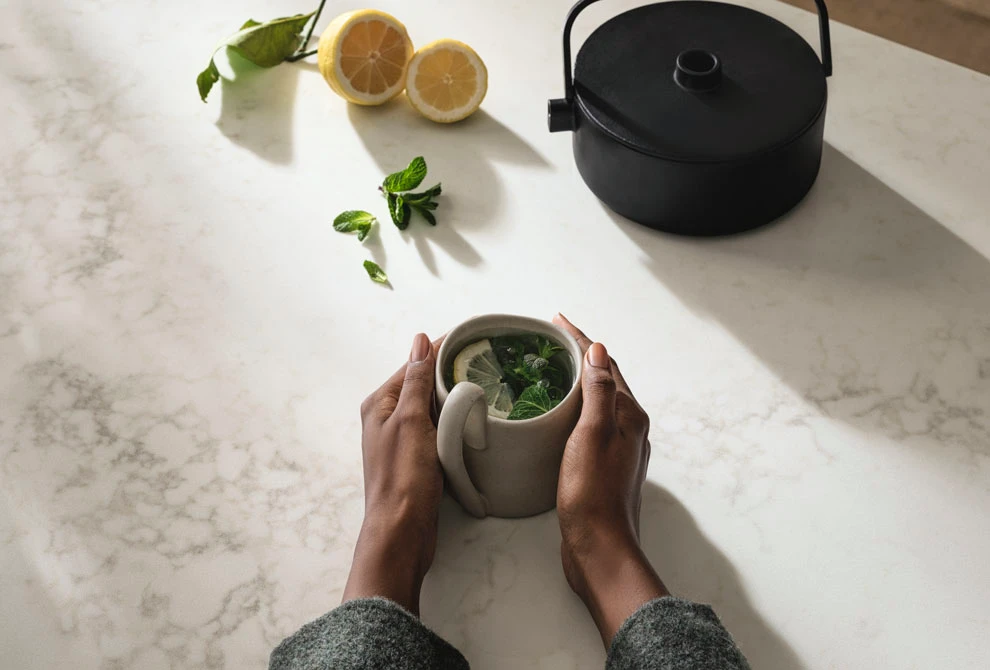
The same logic applies beyond the kitchen, and into the laundry where surfaces work just as hard, and outdoors where the UV-stable Caesarstone® Porcelain holds its own against the elements. That is what makes a premium benchtop worth it.
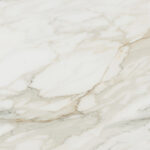
Initial costs vary considerably between natural stone and Caesarstone. Calacatta and Statuario marbles sit at a significant premium over Caesarstone® alternatives that achieve a similar aesthetic. Weight is the second consideration that often goes unmentioned at the point of selection. Marble in particular is heavier than Caesarstone, and timber floor structures may need reinforcing to carry the additional load.
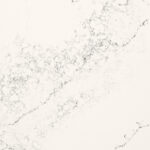
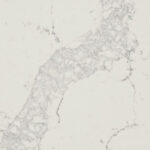
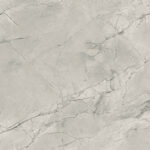
Caesarstone® ICON™ Advanced Mineral Surfaces and Caesarstone® Porcelain™ offer the marble-led aesthetic most homeowners are searching for, without the structural, financial and maintenance considerations that accompany the natural material.
The difference is easier to judge in person than on screen. Visit your nearest Caesarstone® showroom to experience the ICON and Caesarstone® Porcelain collections up close, and speak with a consultant about the right surface for your next project.
Yes. Quartzite is a natural metamorphic stone, formed when sandstone is subjected to heat and pressure over time. It’s harder than marble and is often confused with it visually, which has contributed to its recent popularity in renovations. Like other natural stones, quartzite is porous and requires sealing every one to two years to resist staining. Quartzite also has a high Crystalline Silica content, which is increasingly relevant for both consumers and trade.
Natural stone (marble, granite, limestone, quartzite) is quarried in slab form and cut to size. It’s porous, requires regular sealing, and varies visually from slab to slab, meaning the piece selected in the showroom may differ from the one installed.
Caesarstone® surfaces are engineered. They’re non-porous, scratch and heat resistant, and consistent in colour and veining across slabs. Caesarstone® ICON™ Advanced Mineral Surfaces are also crystalline silica-free*, which is relevant for safety-conscious homeowners and the trades that work with the material.
No. Caesarstone® is an engineered surface, designed to deliver the visual depth associated with natural stone without the porosity, sealing requirements, or vulnerability to etching and staining. Collections including Caesarstone® ICON™ and Caesarstone® Porcelain™ offer marble-inspired aesthetics — among them options such as Brillianza™ — alongside the durability and consistency that natural stone, by its nature, can’t guarantee.
*Caesarstone® ICON™ surfaces may contain traces of crystalline silica of up to 1%.
{{ subtitle }}
{{ subtitle }}
{{ subtitle }}
{{ i.desc }}
{{ subtitle }}
{{ subtitle }}
No worries! We will send you an email to reset your password
If '{{this.email}}' email address exists, we have sent an email with password reset instructions.
Please note: If the email does not show up within one hour, check your spam folder or try to reset your password again after one hour.